Current Startup and Venture Capital News — Saturday, April 4, 2026: Record Quarter for Venture, Capital Concentration in AI, and a New Race for Infrastructure
As we enter April 2026, the global startup and venture capital market has entered a new phase. Formally, the industry is demonstrating record levels of capital raised, yet within this growth an important characteristic is apparent: capital is concentrated in a limited number of large deals, primarily surrounding artificial intelligence, computational infrastructure, defense technologies, and new platforms for cross-border finance. For venture investors and funds, this indicates a shift from a period of widespread capital distribution to a phase of more stringent selection, where startups with technological advantages, infrastructural significance, and clear paths to dominance in their niche prevail.
Against this backdrop, the venture market can no longer be described merely as “growing investments in AI.” It is more accurate to say that the global startup market is restructuring around several strategic directions: computational capacities, sovereign technological infrastructure, defense tech, next-generation fintech, and projects that could become future candidates for IPOs or major M&A deals. These themes are shaping the key agenda for funds, managing partners, and institutional investors as of April 4, 2026.
Record First Quarter: The Venture Market Grows Again, But Growth is Becoming Increasingly Uneven
The first quarter of 2026 has been one of the strongest periods for the global venture market in recent history. At first glance, this appears to be a full return of risk appetite: large rounds are closing faster, valuations of leaders are rising, and institutional investors are once again ready to enter tech stories with significant checks. However, within this positive picture, a crucial nuance emerges: a significant portion of new capital is concentrated in a limited number of large deals rather than being evenly distributed across the startup market.
For venture funds, this entails several key conclusions:
- The startup market has not fully recovered; the recovery is selective.
- The cost of capital is decreasing for the strongest teams, while remaining high for the medium segment.
- Competition for the best deals among leading funds is once again intensifying.
- Investors find it increasingly challenging to identify undervalued assets in the hottest verticals.
This is why news about startups and venture investments today is important not just as an overview of major rounds, but also as an indicator of where capital is becoming systemic and where the market remains cautious.
Artificial Intelligence Remains the Main Magnet for Capital
In 2024 and 2025, AI was the most discussed segment, but by 2026 it has decisively become the main center of attraction for venture capital. Importantly, this now includes not only generative models or applied AI services. Investors are actively funding the entire stack: from foundational models and chips to data centers, orchestration platforms, security solutions, corporate agents, and specialized industry applications.
Currently, three trends are particularly noticeable in the AI segment:
- A sharp rise in early-stage valuations for truly strong AI teams.
- A shift in interest toward infrastructure startups that support the computational boom.
- A strengthening connection between venture capital and major tech corporations.
For investors, this creates a dual situation. On the one hand, AI remains the main driver of returns and the primary source of new "unicorns." On the other hand, it presents the highest risk of overpaying for assets. The most resilient startups are those that build not just an interface above a model, but create a critically important layer of infrastructure, security, data, or industry integration.
A New Race is On: Not Only for Models but Also for Computational Infrastructure
One of the most notable trends in April 2026 is the venture market's shift from a race for AI products to a race for infrastructure. Capital is increasingly flowing into startups that address the fundamental issues of computational capacity, energy supply, chips, and sites for new data centers. This indicates that the startup market is perceiving computational infrastructure as a separate class of super-valuable assets.
In practical terms, this manifests in the following ways:
- Growing interest in AI chips and alternative hardware platforms.
- Funding for new data centers and sovereign computing capacities.
- Emergence of increasingly ambitious startups at the intersection of AI, energy, and space infrastructure.
- Corporate players are increasingly acting not only as clients but also as investors.
For venture investments, this represents an important shift. Funds are no longer only seeking the next successful AI interface. They are looking for companies that can become the foundation of the new digital economy. This is why topics related to computation, semiconductors, electrical energy, cooling, and physical infrastructure are increasingly prominent in the startup agenda.
Defense Tech Has Fully Emerged from Being a Niche Segment
Just a few years ago, defense technologies were a politically sensitive and niche category for some investors. The situation has now changed. Defense tech is becoming one of the fastest-growing areas, and startups in this space are securing large rounds owing to a combination of several factors: technological complexity, high demand from governments, and the rising importance of autonomous systems.
The most interest is drawn by companies working in the following areas:
- Autonomous platforms and unmanned systems.
- AI solutions for military analysis and decision-making.
- Cybersecurity and identity protection.
- Dual-use technologies applicable in both civilian and military contexts.
For global funds, defense tech has ceased to be an exotic domain. On the contrary, it is one of the few segments where large checks coincide with long-term government demand. For the startup market, this signifies an expansion of mandates among funds and an increase in specialized investors ready to work with a longer exit horizon.
Fintech is Making a Comeback Through Stablecoins, Settlements, and Corporate Payments
After a cooling period, fintech is starting to regain weight in startup and venture investment news. However, it is re-emerging in a different configuration. The focus is not on classic neobanks and consumer applications, but rather on infrastructural payment solutions, corporate services, and platforms utilizing stablecoins to accelerate international transactions.
This is an important signal for the venture market. Fintech is no longer being sold merely as a story about "user-friendly interfaces" but is increasingly being presented as a narrative about reducing transactional costs for global businesses. Startups that work with:
- International transfers and FX platforms.
- Corporate real-time settlements.
- Integrating stablecoin infrastructure into B2B finance.
- Automating credit scoring and financial analytics through AI.
For venture funds, this indicates that fintech is once again becoming an attractive investment, though the advantage is shifting from the loudest brands to companies with real infrastructural utility and high monetizability.
Europe and Asia are Strengthening Their Own Startup Ecosystems
Another significant narrative at the beginning of April is the intensifying regional competition for technological leadership. The startup ecosystem is becoming less reliant solely on Silicon Valley. Europe is actively discussing the simplification of regulations for launching companies and accelerating the scaling of innovative businesses, while Asia continues to increase support for semiconductors, private space ventures, industrial AI, and deep tech.
On a global level, this signifies the following:
- Europe strives to reduce regulatory barriers and retain tech companies within the region.
- China is enhancing the state's role in venture financing strategic technologies.
- India is solidifying its status as one of the most interesting markets for private capital in Asia.
- Regional ecosystems are becoming more important for deal selection than before.
For international investors, this opens up new opportunities. In a climate where the hottest American deals are already overheated in valuation, funds are paying increasingly closer attention to European and Asian startups, especially in deep technologies, infrastructure, enterprise software, and the space sector.
The Window for IPOs and Major Exits is Gradually Opening
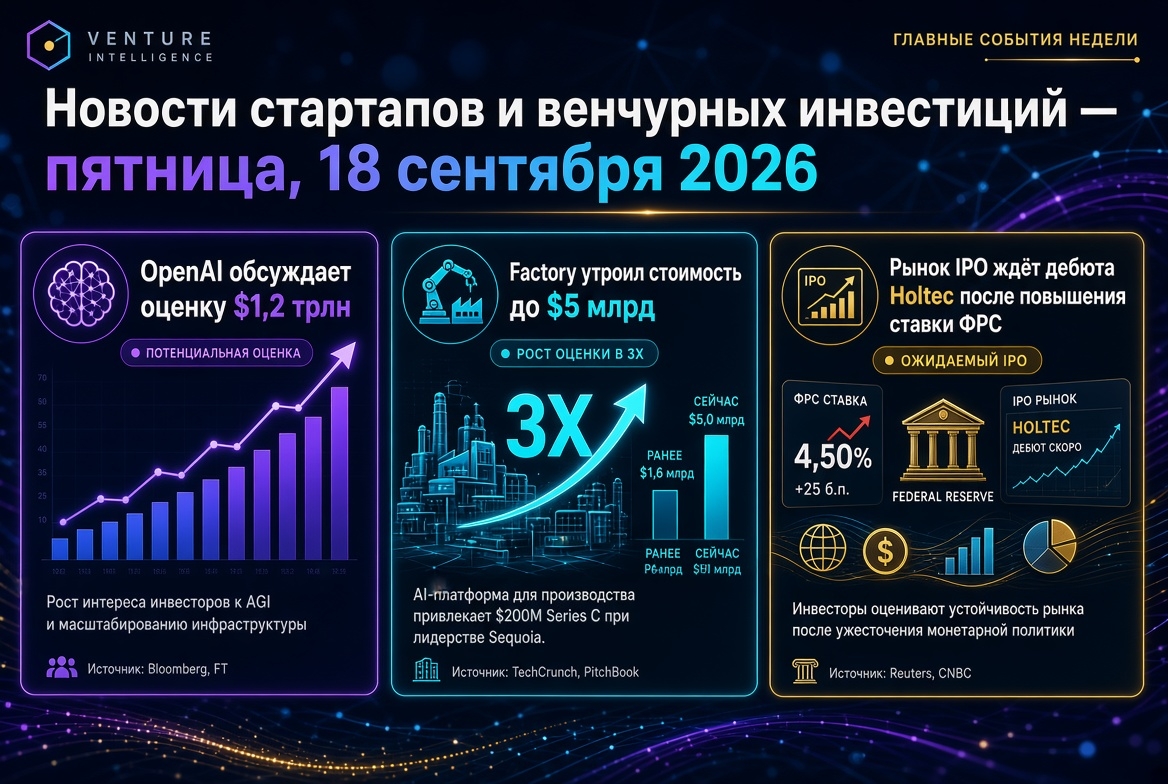
For venture investments, new rounds are not the only focus; exits matter too. This is why the market is closely monitoring signs of a revival in IPOs and major M&A deals. The beginning of 2026 provides a cautiously positive signal: public markets are once again ready to discuss the largest tech placements, and private companies are beginning to build exit strategies more deliberately.
While this is not yet a full-fledged mass IPO cycle, the sentiment is clearly shifting. It is particularly important that companies with the scale capable of returning liquidity to the venture system are back in the agenda. For funds, this means:
- The ability to more realistically assess exit timelines.
- A surge in interest in late-stage and pre-IPO strategies.
- Improved arguments for LPs in new fundraising rounds.
- A gradual restoration of confidence in the technology capital market.
If the IPO window remains open in the second and third quarters of 2026, the startup market could see not only a rise in valuations but a full-scale new cycle of capital redistribution.
What This Means for Venture Investors and Funds Right Now
As of April 4, 2026, the venture market appears strong, yet far from even. Startups are once again receiving large investments, but capital is increasingly discerning in selecting winners. The main takeaway for funds is that the current cycle is favorable not for just any tech company, but for those that intersect several major themes simultaneously: AI, infrastructure, defense, corporate fintech, sovereign technologies, and potential pre-IPO stories.
Investors should pay particular attention to the following signals:
- How quickly capital begins to return to the broader early-stage segment.
- Whether the pace of funding for AI infrastructure can be maintained without overheating valuations.
- Which regions will offer the best deals outside of the U.S.
- Whether the IPO window will be confirmed by real placements and exits.
These questions will determine whether the current growth of venture investments remains sustainable or if the market will once again face overheating phases in certain verticals. For now, the picture is as follows: the global startup market has accelerated again, but only those companies embedded in the strategic contours of the next technological wave are winning.