Practical Checklist of 15 Situations When Traders and Investors Should Avoid Opening Positions: Trading Psychology, Emotion Control, and Capital Protection in Global Markets
Why This Matters: Overtrading as a Hidden Cost
In global markets — from US and European stocks to currencies (FX), commodities, and cryptocurrencies — losses often arise not from "wrong" forecasts but from an incorrect mindset. Overtrading turns volatility into a personal enemy: you pay spreads and commissions, worsen entry prices, increase leverage, amplify errors, and lower decision quality. For investors and traders, discipline is not a moral category but a crucial element of risk management and capital protection.
The Principle of "Do Not Trade" — A Filter for Quality
The phrase "do not trade" may sound radical, but its meaning is pragmatic: trading is a privilege granted only after passing certain filters. In an environment where news, social media, and "hot tips" from the US, Europe, and Asia create constant noise, your trading plan must operate as an access system. If the filters are not met, the trade is not valid — even if it "seems like the right time."
- The goal of the trader's checklist: reduce the share of emotional trading and increase the share of planned trades.
- The outcome: fewer trades, but a higher expected value and a more stable capital curve.
- Key KPI: the quality of trade execution rather than the quantity of entries.
15-Point Checklist: When "Not Trading" is the Best Trade of the Day
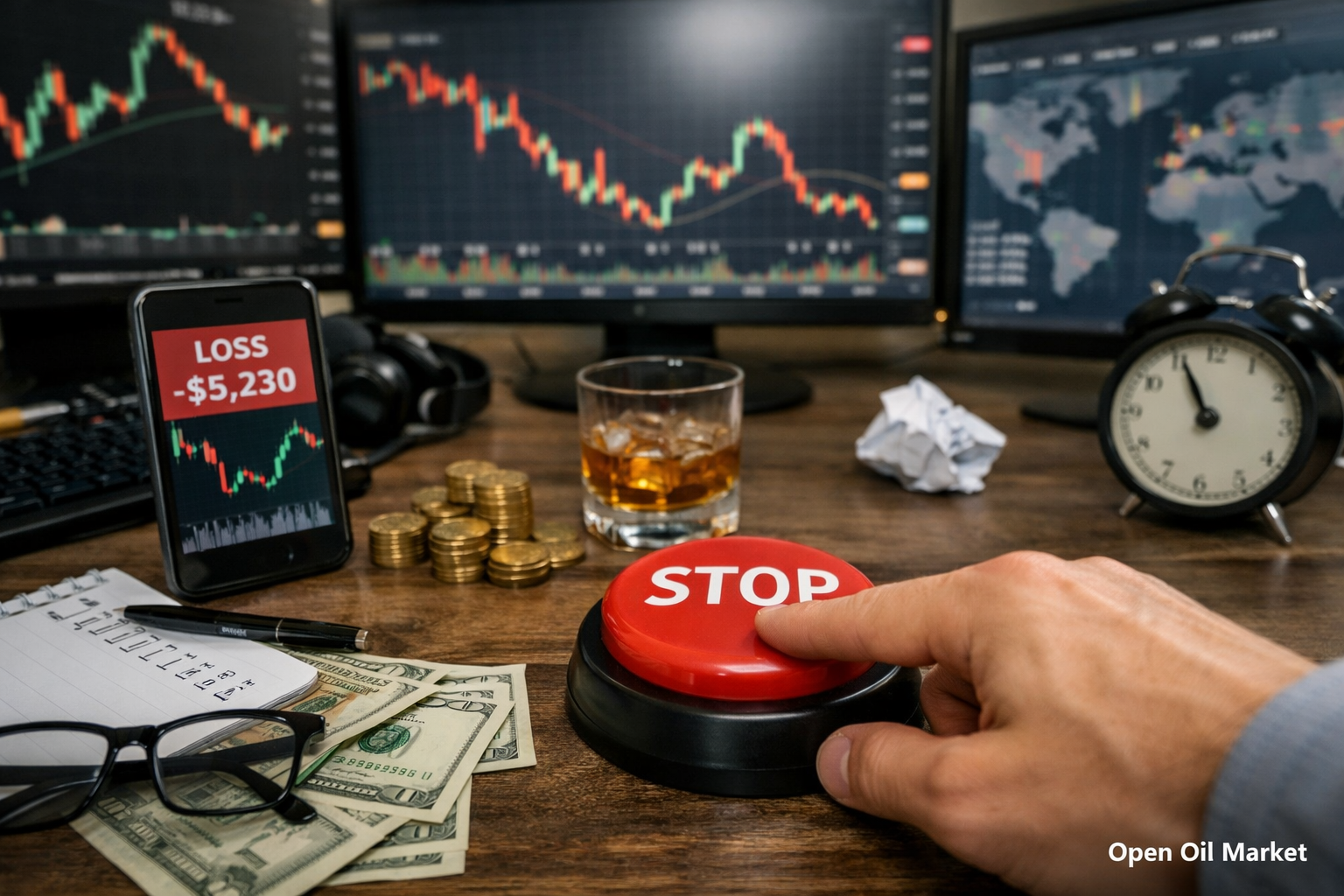
Use this list as a pre-trade check. If even one point applies — click "Pause" instead of "Buy/Sell."
- If you need money urgently — do not trade. Urgency breeds excessive risk, leverage, and attempts to "speed up life" by the market.
- If you feel excitement — do not trade. Excitement undermines risk management and turns a trader's discipline into a game.
- If you do not want to trade — do not trade. Coercion reduces focus and execution quality.
- If you cannot find good options but are desperately looking — do not trade. This is a classic scenario of overtrading.
- If you fear missing a trade (FOMO) — do not trade. The fear of missing out almost always leads to worsened entry prices and delayed decisions.
- If you want to take revenge on the market (revenge trading) — do not trade. Seeking vengeance on the market is a direct path to a series of losing trades and increased leverage.
- If your intuition warns "it is not worth it" — do not trade. This is often a signal of unnoticed violations in your trading plan or unaccounted risk.
- If you are upset or depressed — do not trade. Negative emotions distort probability assessments and increase the tendency to "force" a trade.
- If you are euphoric — do not trade. Euphoria creates an illusion of control and leads to excessive risk.
- If you are tired, unwell, irritated, or distracted by personal matters — do not trade. Fatigue reduces reaction, memory, and discipline.
- If you read somewhere that "now is the best time" — do not trade. Someone else's thesis does not replace your model, risk profile, and horizon.
- If you missed the entry and want to "jump on the last train" — do not trade. Chasing movement is a frequent source of poor risk/reward ratios.
- If the trade does not fit into your trading plan — do not trade. Without a plan, you are trading emotions, not ideas.
- If you do not understand what is happening in the market — do not trade. Uncertainty about the market regime (trend/flat/news surge) increases the probability of errors.
- If you have already reached your limit of trades for the day — do not trade. A limit is essential for risk management and protection against overtrading.
Admission Rule: Only trade when you have exhausted all reasons not to trade. This represents the fundamental psychological protection of capital.
How to Turn the Checklist into a System: 30 Seconds Before Entry
To ensure that trading psychology does not remain a "nice idea," turn it into a procedure. Before each trade, answer "yes/no" to four questions:
- State: Am I calm and focused, without FOMO or a desire to redeem myself?
- Plan: Is this trade part of my trading plan, with a clear scenario and cancellation level?
- Risk Management: Is my stop loss, position size, and risk in percentage of capital known?
- Context: Do I understand the current market regime (US/Europe/Asia), liquidity, and volatility?
If even one answer is "no," the trade is prohibited. Such simple logic drastically reduces the share of emotional trading, especially during periods of news turbulence.
Risk Management vs. Emotions: What to Include in the Trading Plan
A trading plan is a contract with yourself. It should be concise, actionable, and measurable. For investors and traders operating in global markets, it is sufficient to document the following rules:
- Risk Limit per Trade: a fixed percentage of capital (e.g., 0.25–1.0%), without exceptions.
- Daily Stop Limit: a level of loss after which trading ceases until the next session.
- Daily Trade Limit: a predetermined number of entries; exceeding this is a sign of overtrading.
- Entry Standards: setup criteria, confirmations, and "do not trade" conditions.
- Ban on "Averaging Down": no increasing leverage or doubling positions after a loss.
These points transform trader discipline into a technology: emotions remain but do not gain the right to control volume, leverage, and trade frequency.
Global Context: Why Noise is Particularly Dangerous for Investors
The information flow regarding US stocks, European indices, Asian markets, oil, and currencies creates the illusion that "something unique is happening right now." In practice, uniqueness often pertains more to headlines than to your risk profile. When you react to every impulse, your strategy devolves into improvisation. And the higher the volatility, the faster overtrading erodes capital — through worsened prices, slippage, and a chain of emotional decisions.
The psychology of trading here is straightforward: you are not obligated to participate in every movement. You are obligated to protect capital and act according to your plan.
Mini Protocol for Recovery After a "Blown" Day
If you have violated your rules (exceeded your trading limit, traded out of FOMO, or tried to redeem losses), a short protocol is necessary to regain control:
- Stop trading for 24 hours or until the next session, regardless of "opportunities."
- Analyze 3 Facts: What did I feel, which rule did I violate, and what was the cost of the violation in monetary terms and capital percentage?
- One Corrective Point in the trading plan (not ten): for example, reduce risk per trade or decrease the number of trades.
- Return with Minimal Risk on the first 3–5 trades to restore execution discipline.
This way, you convert a "failure" from an emotional drama into a managed risk management process.
Final Thought: Discipline as a Competitive Advantage
In highly competitive global markets, an advantage is rarely created through a "super idea." It is created through a stable process: trading plan, risk management, trade limits, and the ability to tell yourself "do not trade" at the moment when you want to press the button. The checklist of 15 points serves as a practical tool that cuts out impulsive decisions, reduces overtrading, and helps investors and traders preserve the most important thing — capital and clarity of thought.