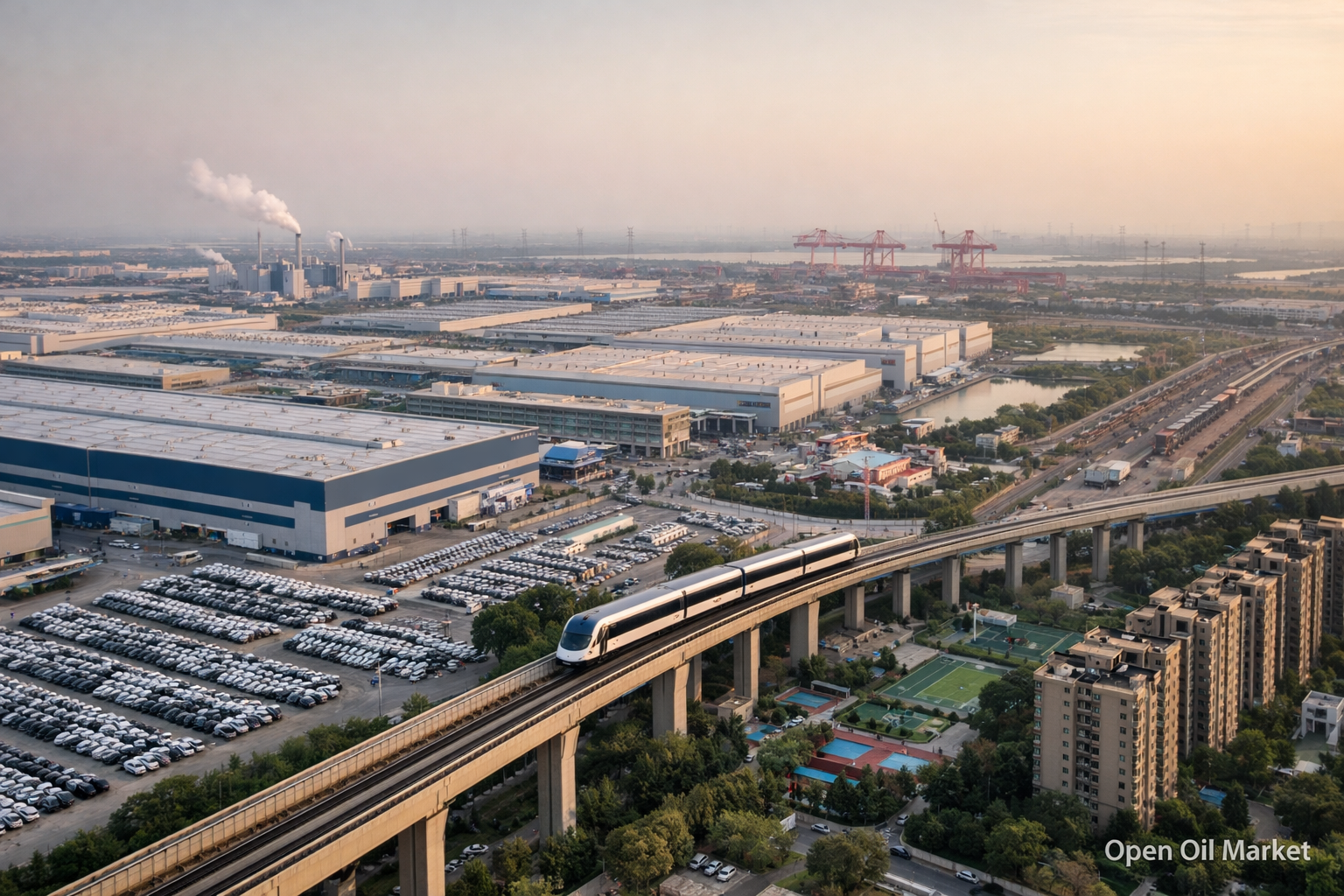
BYD's Gigafactory in Zhengzhou: One of the Largest Industrial Projects in the World. Analyzing Scale, Production Economics, and Significance for the Global Electric Vehicle Market and Investors.
Project Scale: Where Viral Numbers End and Measurable Facts Begin
The story of “the BYD factory is larger than San Francisco, Paris, or Barcelona” became viral, as it presents the perfect metaphor: electric vehicle production is transforming into a new industrial infrastructure on a city level. In practice, what is more important for investors is not the comparison to megacities, but operational metrics: the current area of the production contour, expansion dynamics, workforce size, actual output, and planned capacity.
Public estimates based on satellite images indicate that the industrial “footprint” of the site in Zhengzhou measures tens of square kilometers, while claims of 130 km² more often reflect the expanded territory of the industrial zone/cluster and development plans. This also applies to employee numbers: media reports often mention “100,000 employees,” but for investment analysis, confirmed benchmarks regarding employment and staff recruitment, as well as productivity, are crucial.
Electric Vehicle Production as an Industrial Platform: Economies of Scale and Cost Structure
BYD is building a competitive advantage not only through its product line but also through industrial economies of scale. For the EV market, this is critical: the cost of batteries, power electronics, and assembly directly determines the price corridor within which the company can engage in price competition without jeopardizing margin. The “city-factory” in Zhengzhou represents an attempt to establish a low unit cost of electric vehicle production over the next several years.
- Reduction of unit costs: large volumes lead to more favorable material and component procurement, line loading, and capital expenditure amortization.
- Speed of output: with stable logistics and refined automation, the cycle from “components → vehicle” is shortened.
- Flexibility of the product range: A large base easily accommodates the launch of new models, distributing risks between platforms and segments.
BYD's Vertical Integration: Batteries, Components, and Supply Chain Control
For investors, BYD's vertical integration is a central element of the case. In electric vehicles, the cost of batteries and power components remains dominant, meaning that control over battery lines, modules, and key assemblies simultaneously protects margins and guards against supply chain disruptions.
Zhengzhou is important as a hub where electric vehicle production and the development of a component base reinforce each other: expanding capacity for battery components enhances the site's autonomy and reduces dependency on external suppliers during periods of price shocks or technology export restrictions.
Actual Volumes and Growth Trajectory: Why "1 Million Cars Per Year" Is Not Just Marketing
The market is closely monitoring Zhengzhou, as the site demonstrates a rare scaling speed for the automotive industry: increasing output by hundreds of thousands of cars per year is possible only through a combination of capital expenditure, automation, workforce reserves, and a local industrial cluster. Public data indicates output targets on the order of hundreds of thousands of vehicles per year, with plans to elevate capacity to "1 million+" in subsequent expansion phases.
- Actual output: Important as an indicator of line loading and production system maturity.
- Planned capacity: Vital as a revenue scenario, but investors need to discount timelines and input risks.
- Workforce dynamics: Hiring tens of thousands of employees signals a commitment to accelerate the introduction of new lines and R&D contours.
Logistics and Export: Zhengzhou as an “Internal Port” for Global Sales
For global investors, the BYD factory in Zhengzhou is not just assembly but also logistical design. Chinese electric vehicle manufacturers benefit when export channels are integrated into the industrial geography: railway routes, multimodal hubs, and proximity to suppliers reduce timelines and free up working capital.
Looking toward 2026, the significance of exports is increasing: BYD is publicly ramping up its ambitions for sales outside China, balancing targets between Europe, North America, and ASEAN countries. To assess the sustainability of this strategy, investors must observe how quickly the company increases shipments and localizes assembly in regions with tariff barriers.
Competition: Pressure on Tesla, European Brands, and the Pricing Architecture of the EV Market
The expansion of BYD's production base intensifies competition across two dimensions. The first is price: reducing unit costs allows for increased market share in the mass segment of electric vehicles and hybrids. The second is speed: bringing models to market faster and adapting configurations to regional requirements more swiftly.
- Europe: Sensitive to price and localization; the growth of BYD's presence amplifies pressure on the margins of traditional automakers.
- USA and North America: High barriers and policy considerations; here, partnership strategies, local assembly, and regulatory compliance are more critical.
- ASEAN and the Middle East: Growth markets where the combination of price and supply can lead to a rapid increase in share.
Risks for Investors: Tariffs, Regulation, Demand Cyclicality, and Capital Expenditure Race
The larger the “city-factory,” the higher the bets on continuous loading. In the EV segment, this increases sensitivity to four key risks: trade barriers, regulatory changes, price wars, and volatility in consumer demand.
- Tariff and non-tariff measures: May shift the economics of exports and accelerate the need for localization in Europe and other regions.
- Price competition in China: With overheated capacities, the market may pressure margins, especially in the mass segment.
- Capital expenditure and payback period: Large expansions require discipline—from input schedules to working capital management.
- Technological race: Batteries, power electronics, software; falling behind quickly turns into discounts and reduced customer lifetime value.
Practical Checklist: What to Track in 2026
If you are considering BYD and the entire electric vehicle sector as an investment theme, the “megafactory in Zhengzhou” should be seen as a dashboard: it indicates how capable the company is of simultaneously scaling electric vehicle production and supply chains.
- Actual capacity utilization and growth rates of output at the Zhengzhou site.
- Hiring dynamics (manufacturing, R&D, quality) and labor productivity amidst automation.
- Battery cost structure and stability of material supplies for key items.
- Export mix: share of Europe, North America, and ASEAN; speed of dealer network and service infrastructure expansion.
- Capital expenditure profile: signs of slowing/accelerating investments and their connection to margins.
Why BYD’s “City-Factory” Is a Signal of a New Industrial Norm
There is a lot of noise surrounding BYD in Zhengzhou—from comparisons of size with cities to impressive shots of the “living” infrastructure. For investors, the main point is different: it visualizes the new norm in the automotive industry, where leadership is determined by industrial scalability, vertical integration, and supply chain control. If BYD maintains its pace of expansion without compromising on quality and margin, the “megafactory” will become not just a symbol but a source of sustainable advantage in the global EV market.